

Amla for Skin: The Ancient Indian Superfruit Your Skin Has Always Needed
Your grandmother knew about it. Ayurvedic texts documented it over 5,000 years ago. And now, modern cosmetic science is catching up - confirming what Indian skincare tradition never doubted. Amla, the small green fruit that has sat quietly in your kitchen and your ancestors' rituals, is one of the most powerful skin ingredients on the planet.
And it has always been hiding in plain sight.
What Is Amla?
Amla - also known as Indian gooseberry, or Amalaki in Sanskrit - is the fruit of the Phyllanthus emblica tree, native to the Indian subcontinent. It is tart, dense, and remarkably resilient. In Ayurveda, it is considered a Rasayana - a class of ingredients believed to promote longevity, renewal, and deep nourishment from within.
But what makes amla extraordinary for skin is not legend. It is chemistry.
Why Amla Is a Skincare Powerhouse
The Highest Natural Source of Vitamin C
Amla contains one of the highest concentrations of Vitamin C found in any natural source - significantly more than oranges, and in a form that is far more stable. This matters because Vitamin C is the cornerstone of brightening, collagen synthesis, and antioxidant defence. It neutralises free radicals from UV exposure and pollution - two things Indian skin faces relentlessly every single day.
The result? Over time, skin that is visibly brighter, more even, and more resilient.
A Natural Collagen Supporter
Vitamin C is essential for the body's ability to produce and maintain collagen - the protein responsible for skin's firmness and elasticity. As we age, collagen production slows. Amla's dense nutrient profile supports the skin's natural collagen environment, keeping the surface supple and less prone to the fine lines that creep in with sun exposure, stress, and time.
Deeply Antioxidant
Beyond Vitamin C, amla is rich in tannins, flavonoids, and polyphenols - a layered antioxidant defence system that protects the skin at multiple levels. These compounds combat oxidative stress, reduce inflammation, and help the skin recover from daily environmental damage before it accumulates into visible ageing.
Naturally Brightening
Amla inhibits excess melanin production - the process responsible for uneven skin tone, dark spots, and the kind of post-inflammatory hyperpigmentation that is particularly common in Indian skin after sun exposure or breakouts. It brightens without bleaching, evens without erasing - a crucial distinction.

Amla and Indian Skin - A Natural Match
Indian skin carries a unique set of needs. Higher melanin concentration means greater susceptibility to hyperpigmentation. Year-round UV exposure accelerates oxidative stress. Heat and humidity can compromise the skin barrier while simultaneously triggering excess oil.
Amla addresses all of these with quiet precision. It is not a harsh active that forces results. It is an intelligent botanical that works with the skin's existing biology - stimulating, protecting, and restoring rather than stripping or shocking.
This is exactly why Ayurveda placed Amalaki at the top of its skin ingredient hierarchy. Not out of tradition for tradition's sake - but because thousands of years of observation produced a very accurate conclusion.
Amla vs. Synthetic Vitamin C - What's the Difference?
You will find Vitamin C in many skincare products, usually as L-ascorbic acid. It works - but it is notoriously unstable, oxidising quickly and losing potency when exposed to light and air. It can also irritate sensitive skin at higher concentrations.
Amla delivers Vitamin C alongside its natural co-factors - the tannins, flavonoids, and trace minerals that occur alongside it in the fruit. These co-factors improve absorption, enhance stability, and reduce the risk of irritation. It is the difference between a nutrient in isolation and a nutrient in its natural context.
For skin that has reacted to synthetic Vitamin C serums in the past, amla is often the gentler, equally effective alternative.
How Auumora Uses Amla
At Auumora, we do not believe in skincare routines. We believe in rituals - intentional, sensorial, and deeply considered. Amalaki is one of our hero Ayurvedic ingredients, chosen not for its heritage alone, but for the measurable skin benefits it delivers when formulated correctly.
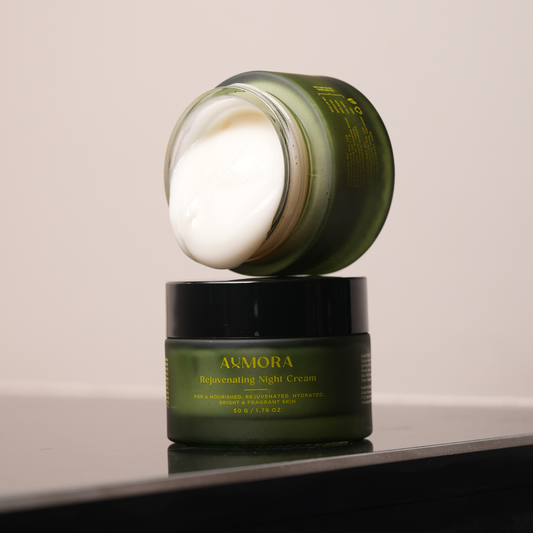
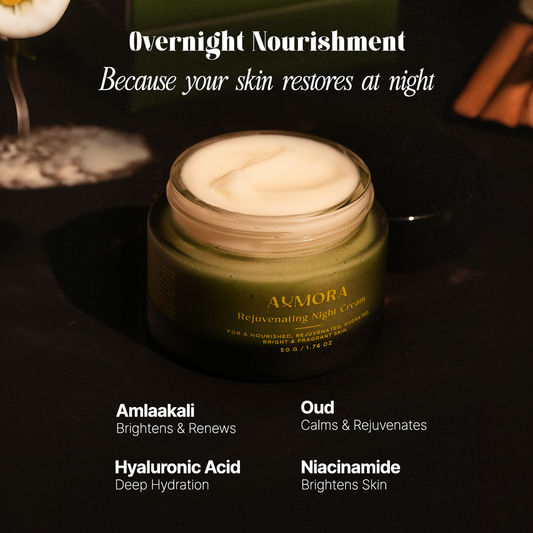
In the Auumora Rejuvenating Night Cream, amla works overnight alongside Ashwagandha, Niacinamide, Hyaluronic Acid, and Glycolic Acid. While you sleep, this combination targets uneven tone, supports skin renewal, and builds the kind of quiet, lasting radiance that does not wash off in the morning.
This is what a ritual built with intention looks like - an ancient ingredient given the right modern partners to deliver its full potential.
How to Bring Amla Into Your Ritual
The most effective way to use amla for skin is through a well-formulated product where it is properly extracted, stabilised, and blended at the right concentration. Raw amla juice applied directly to the face is highly acidic and can cause irritation, especially on sensitive skin.
Look for amla - or its botanical name, Phyllanthus emblica or Amalaki - in night creams, serums, and body care formulations where it has been processed to deliver maximum benefit without the acidity of the raw fruit.
The Conclusion
Amla is not a trend imported from a foreign ingredient list. It is Indian. It belongs to this soil, this climate, this skin. Five thousand years of Ayurvedic use and a growing body of modern research point to the same conclusion - this small, tart, unassuming fruit is one of the most complete skin ingredients in existence.
Brightening. Protective. Collagen-supporting. Anti-inflammatory. And completely natural.
Your skin has always needed it. Now you know why.
Discover the power of Amalaki in the Auumora Rejuvenating Night Cream - not a step in a ritual, but a moment of ritual your skin deserves every night.
Shop Now at auumora.com
Tags:
Related articles



Benefits of Hyaluronic Acid for Face and Body
May 19 2026