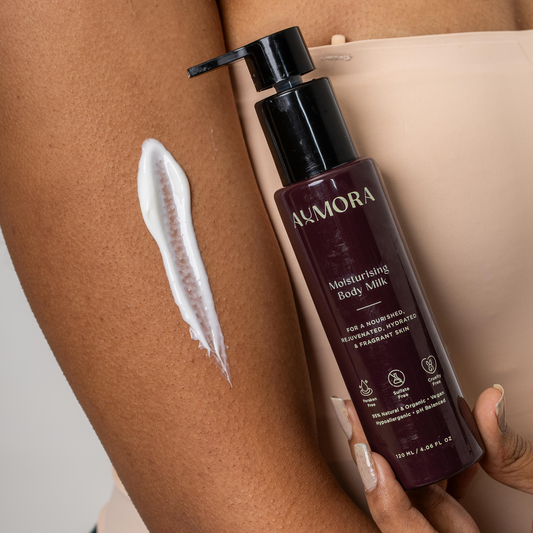


Why Your Skin Needs a Night Routine - And What Happens When You Skip It
Your skin takes a beating during the day. UV rays, pollution, heat, and screen exposure all quietly chip away at your skin barrier - breaking down collagen, triggering inflammation, and leaving behind oxidative damage that doesn't always show up immediately. The dullness, the uneven tone, the fine lines that seem to appear out of nowhere - most of it traces back to daytime damage that was never properly addressed.
That's where your night routine comes in. While you sleep, your body shifts into repair mode. Cell turnover speeds up, collagen production increases, and the skin barrier works to recover what was lost. The question isn't whether your skin repairs at night - it does, with or without your help. The question is whether you're giving it the right support to do it well.
What Actually Happens to Your Skin During the Day
Daytime is survival mode for your skin. From the moment you step outside, your skin is actively defending itself - against UV radiation, pollution particles, humidity changes, and oxidative stress. It's doing its job, but that job comes at a cost.
UV damage goes deeper than a tan
Most people understand that sunscreen is important, but fewer understand the full extent of what daytime exposure does to the skin. UV radiation is the leading cause of premature ageing - it breaks down collagen fibres, disrupts melanin production, and generates free radicals that damage skin cells at a cellular level. Pollution adds another layer of harm, depositing particulate matter onto the skin surface that clogs pores and triggers low-grade inflammation. Even indoor factors like dry air conditioning and blue light from screens have been linked to dehydration and barrier disruption.
By the time evening arrives, your skin is carrying all of that. A quick rinse and moisturiser won't cut through the accumulated damage - you need a routine that's built specifically for what night can do.
Why Nighttime Is the Best Time for Skin Repair
This isn't just skincare logic - it's biology. Your body runs on a circadian rhythm, and skin repair is one of the processes that peaks after dark. Understanding this helps you work with your skin rather than against it.
our skin is more receptive after dark
Skin cell turnover - the process of shedding old cells and generating new ones - is significantly more active at night. Cortisol levels drop and melatonin rises, which signals the body to shift from protection mode to regeneration mode. Blood flow to the skin increases, making it more receptive to active ingredients. This is why the same ingredient applied at night often delivers better results than when used in the morning.
No sun interference means actives can work fully
Many powerful skincare ingredients - like Glycolic Acid and Niacinamide - are either sun-sensitive or work best without UV exposure. Using them at night means they can do their job without being broken down by sunlight or increasing photosensitivity. This is also why a dedicated night cream formulated with these actives makes a meaningful difference compared to using a generic moisturiser.
Image 2 suggestion: A person applying cream to her face
What a Good Night Routine Should Actually Do
Not every night cream or routine is built equally. The difference between one that works and one that just sits on your skin comes down to whether it addresses the right things - in the right order.
Repair the barrier
Daytime damage weakens the skin barrier, making it harder for skin to retain moisture and easier for irritants to get in. A good night routine should focus first on restoring this barrier - through ingredients that support hydration and reduce inflammation.
H3: Address sun damage at the cellular level
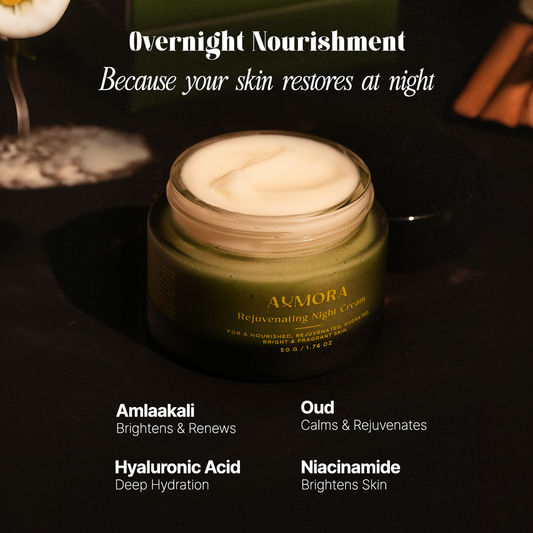
This is where ingredients like Amlalaki - the Ayurvedic name for Indian Gooseberry - become important. Amlalaki is one of the richest natural sources of Vitamin C and antioxidants, and it works to neutralise free radical damage caused by UV exposure while brightening uneven skin tone over time.
Stimulate collagen and renewal
Ingredients like Ashwagandha and Glycolic Acid support the skin's renewal process. Ashwagandha is an adaptogen that reduces oxidative stress and supports skin elasticity, while Glycolic Acid gently exfoliates the surface to encourage faster cell turnover - revealing fresher skin underneath.
Deeply hydrate and plump
Skin loses more water at night than during the day, a process called transepidermal water loss. Hyaluronic Acid addresses this directly, pulling moisture into the skin and helping it stay there through the night - so you wake up to skin that looks plumper and more rested.
A Night Cream That Does the Heavy Lifting
Most night creams promise overnight transformation but deliver very little by morning. What separates an effective night cream from a forgettable one is the quality and combination of its ingredients - and whether those ingredients are actually doing something while you sleep.
Where Ayurveda meets modern science
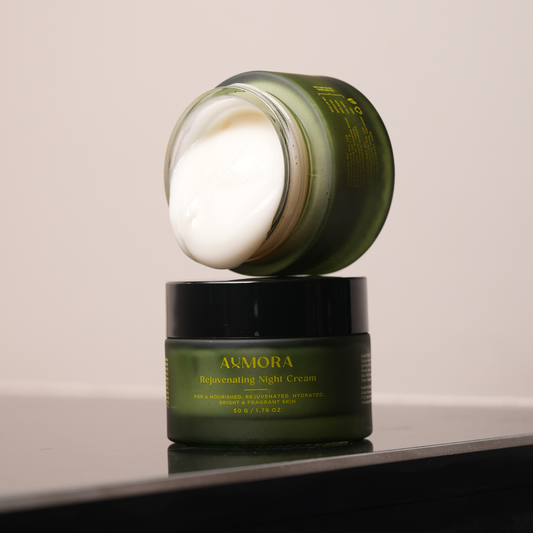
If you're looking for a single product that brings all of this together, the Auumora Rejuvenating Night Cream was formulated with exactly this in mind. It combines Amlalaki and Ashwagandha - two time-tested Ayurvedic actives - with Niacinamide, Hyaluronic Acid, and Glycolic Acid, all infused with the grounding scent of Oud. Together, these ingredients target sun damage, dehydration, dullness, and uneven tone through the course of a single night. It's not about adding more steps to your routine. It's about making the hours you're already sleeping work harder for your skin.
Final Thoughts
Consistency is what turns a good night routine into visible results. One night of proper skincare won't undo months of sun damage - but a few weeks of the right routine will. Your skin is already doing the hard work after dark. The only question is whether you're giving it what it needs to finish the job.
Tags:
Previous
Benefits of Hyaluronic Acid for Face and Body
Next
Top 10 Benefits of Ashwagandha for Skin, Body and Mind
Related articles





Benefits of Hyaluronic Acid for Face and Body
May 19 2026